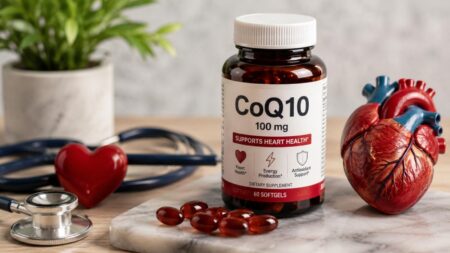
The best CoQ10 supplements for heart health in 2026 combine a clinically studied dose of 100 mg to 200 mg with a fat-soluble delivery form such as a softgel. Brands including Qunol, Doctor’s Best, and Life Extension lead this category because they publish third-party test results and use ubiquinol, the form your body absorbs most easily.
This guide ranks 7 supplements by dose, form, and lab verification. You will also learn how coenzyme Q10 (CoQ10) supports your cardiovascular system and how to pick a product that matches your specific heart health goal.
Demand for CoQ10 has grown alongside rising rates of statin prescriptions and heart failure diagnoses worldwide. Cardiologists now recommend CoQ10 more often than they did 10 years ago, particularly for patients managing fatigue linked to statin therapy.
What Are the Best CoQ10 Supplements for Heart Health in 2026?
Qunol Mega Ubiquinol CoQ10 ranks as the top pick for general heart support in 2026. This softgel delivers 100 mg of ubiquinol in a water- and fat-soluble base that improves absorption over standard powder capsules.
Doctor’s Best CoQ10 with BioPerine ranks second. This capsule pairs 100 mg of ubiquinone with black pepper extract, which increases absorption by approximately 30 percent based on published research in the Journal of Medicinal Food.
Life Extension Super Ubiquinol CoQ10 ranks third for people who want a higher 100 mg to 200 mg dose paired with shilajit, a mineral compound that supports mitochondrial energy output.
People managing high cholesterol, recovering from a cardiac procedure, or experiencing statin-related fatigue benefit most from this list. Healthy adults under 35 years without a heart condition can often meet their needs through diet and a lower 100 mg maintenance dose.
Ubiquinol vs Ubiquinone: Which Form Supports Your Heart Better
Ubiquinol is the reduced, active form of CoQ10 that your body uses directly in cellular energy production. Ubiquinone is the oxidized form that your liver must convert into ubiquinol before use.
Adults under 40 years absorb ubiquinone efficiently because their conversion process runs at full capacity. Adults over 40 years often benefit more from ubiquinol because natural conversion slows with age.
Both forms raise blood CoQ10 levels effectively when you pair the capsule with a fat-containing meal. Price differences between the 2 forms often reflect manufacturing complexity rather than a meaningful gap in heart health outcomes.
3 Dosage Ranges for Different Heart Health Goals
- General heart maintenance requires 100 mg per day, taken with breakfast or dinner, and suits adults without a diagnosed cardiac condition.
- Statin-related muscle support requires 200 mg per day, split into two 100 mg doses, and targets the fatigue many statin users report.
- Heart failure protocols studied in clinical trials use 300 mg per day, divided into three 100 mg doses taken with meals under a cardiologist’s supervision.
How Does CoQ10 Support Your Cardiovascular System?
CoQ10 fuels the mitochondria inside your heart muscle cells, and your heart holds the highest CoQ10 concentration of any organ in your body. This concentration exists because your heart beats roughly 100,000 times per day and needs a constant energy supply.
Natural CoQ10 production peaks around age 20 and then declines steadily. By age 60, your body produces roughly half the CoQ10 it made at age 20, which directly reduces the fuel available to your heart muscle.
Mitochondrial Energy Production in Heart Muscle
Heart muscle cells contain far more mitochondria than skeletal muscle cells, sometimes 3 times as many. CoQ10 sits inside the mitochondrial membrane and transports electrons during adenosine triphosphate (ATP) production.
Low CoQ10 levels reduce ATP output, and reduced ATP output weakens heart muscle contraction over time.
Oxidative Stress Reduction
CoQ10 neutralizes free radicals before they damage the lipid layer of your heart cells. This antioxidant action protects low-density lipoprotein (LDL) cholesterol from oxidation, a process linked to plaque buildup in your arteries.
Statin medications lower cholesterol by blocking an enzyme called HMG-CoA reductase, and this same enzyme pathway produces your body’s natural CoQ10. This shared pathway explains why statin users often show blood CoQ10 levels 40 percent lower than non-users.
Top 7 CoQ10 Supplements for Heart Health in 2026
These 7 supplements meet 3 core criteria: a verified per-capsule dose, third-party testing, and a heart-relevant delivery form.
- Qunol Mega Ubiquinol delivers 100 mg of ubiquinol in a softgel built for higher absorption. Independent lab testing verifies the label claim on every batch.
- Doctor’s Best CoQ10 with BioPerine pairs 100 mg of ubiquinone with black pepper extract for improved uptake. This option suits budget-conscious buyers who still want an absorption enhancer.
- Life Extension Super Ubiquinol provides 100 mg to 200 mg alongside shilajit for mitochondrial support. Older adults managing statin-related fatigue often choose this higher-strength option.
- Nordic Naturals CoQ10 combines 100 mg of CoQ10 with fish oil in a single softgel. This format reduces the total number of capsules you take each day.
- Jarrow Formulas QH-Absorb uses Kaneka-sourced ubiquinol at a 100 mg dose per softgel. Kaneka is the same Japanese manufacturer that supplies ubiquinol to several premium brands.
- NOW Foods CoQ10 offers a 100 mg capsule at a lower price per serving for daily maintenance. This brand suits shoppers who want a certified, no-frills option.
- Thorne Omega+CoQ10 blends 30 mg of CoQ10 with fish oil for combined cardiovascular support. NSF Certified for Sport status makes this pick popular among competitive athletes.
| Brand | Form | Dose per Serving | Best For |
| Qunol Mega Ubiquinol | Softgel | 100 mg | General heart maintenance |
| Doctor’s Best with BioPerine | Capsule | 100 mg | Budget absorption boost |
| Life Extension Super Ubiquinol | Softgel | 100-200 mg | Higher-dose mitochondrial support |
| Nordic Naturals CoQ10 | Softgel | 100 mg | Combining with omega-3 |
| Jarrow Formulas QH-Absorb | Softgel | 100 mg | Kaneka-sourced ubiquinol |
| NOW Foods CoQ10 | Capsule | 100 mg | Lowest cost per serving |
| Thorne Omega+CoQ10 | Softgel | 30 mg + fish oil | Combined omega-3 and CoQ10 |
Compare price per serving, not price per bottle, when you shortlist from this table. A bottle priced higher but containing 200 servings often costs less per day than a cheaper bottle with 30 servings.
How to Choose the Right CoQ10 Supplement for Your Heart
Selecting the right CoQ10 supplement requires you to check 3 factors together: dose, form, and lab verification. Skipping any single factor increases your chance of choosing an underdosed or poorly absorbed product.
Check the Milligram Dose Per Serving
Confirm the label lists 100 mg or more of CoQ10 per serving, not per bottle. Products that hide the true per-capsule dose inside a proprietary blend make daily dosing inconsistent.
Match the Form to Your Absorption Needs
Choose ubiquinol if you are older than 40 years or manage an existing heart condition. Choose ubiquinone if you are younger than 40 years and want a lower-cost option.
Many cardiologists also recommend magnesium complex supplements alongside CoQ10 because magnesium supports the same mitochondrial ATP pathway.
Confirm Third-Party Testing and Certifications
Look for United States Pharmacopeia (USP), NSF International, or ConsumerLab verification on the label. These marks confirm the capsule contains the labeled dose without heavy metal contamination.
Who Should Avoid CoQ10 Without Medical Guidance
Pregnant women, breastfeeding mothers, and people scheduled for surgery within 7 days should avoid starting CoQ10 without medical guidance. Surgeons often ask patients to pause CoQ10 before a procedure because of its mild effect on blood clotting.
Children under 18 years should not take adult-strength CoQ10 doses unless a pediatric cardiologist prescribes a specific amount for a diagnosed condition.
How to Take CoQ10 Supplements for Maximum Heart Benefit
To take CoQ10 supplements effectively, swallow your capsule with a meal that contains at least 10 grams (0.35 oz) of fat. Fat-soluble CoQ10 absorbs poorly on an empty stomach.
Split doses above 100 mg into 2 servings across your day, once with breakfast and once with dinner. Store your bottle below 25°C (77°F) to protect softgel integrity.
If you miss a dose, take it with your next meal rather than doubling up later. CoQ10 builds up gradually in your blood over 2 to 4 weeks, so a single missed day rarely affects your overall heart health progress.
| Task | Timing | Method | Difficulty |
| Take CoQ10 capsule | With breakfast | Swallow with fat-containing food | Easy |
| Split high dose | Morning and evening | Divide 200 mg into two 100 mg doses | Easy |
| Pair with vitamin E | Same meal as CoQ10 | Take alongside CoQ10 for combined antioxidant effect | Moderate |
| Track blood levels | Every 3 months | Request a CoQ10 blood panel from your doctor | Moderate |
| Adjust dose before surgery | 7 days before a cardiac procedure | Consult your cardiologist on pausing CoQ10 | Difficult |
Can You Take CoQ10 With Statins and Heart Medications?
Yes, most cardiologists approve CoQ10 alongside statin medications. Statins block the same liver pathway that produces natural CoQ10, so supplementation may restore levels the drug depletes.
Some patients pair CoQ10 with nattokinase heart supplements for combined circulatory support, but confirm this combination with your doctor first because both ingredients influence blood clotting pathways.
Warfarin users need caution because CoQ10 shares a structural similarity with vitamin K and may reduce the drug’s blood-thinning effect. Talk to your prescribing doctor before combining CoQ10 with warfarin.
Beta-blockers and ACE inhibitors show no known negative interaction with CoQ10 in current research. Patients taking these blood pressure medications can typically add CoQ10 without a dose adjustment, though you should still confirm this with your cardiologist.
What Do Clinical Studies Say About CoQ10 and Heart Failure?
The Q-SYMBIO trial followed 420 heart failure patients for 2 years and found that 300 mg of daily CoQ10 reduced cardiovascular deaths by 43 percent compared to placebo.
Researchers linked this outcome to improved ejection fraction, the percentage of blood your left ventricle pumps out with each contraction.
Smaller trials on ischemic heart disease and post-surgical recovery report similar reductions in hospital readmission rates among patients taking 200 mg to 300 mg daily.
The KiSel-10 trial combined 200 mg of daily CoQ10 with selenium in older adults over 4 years and recorded a significant drop in cardiovascular mortality compared to placebo. Researchers attributed this result to reduced oxidative damage in heart tissue.
Best CoQ10 Supplements for Bangladesh Buyers: Availability and Import Tips
Bangladesh buyers can source verified CoQ10 brands through licensed pharmacy chains in Dhaka, Chattogram, and Sylhet, or through authorized online retailers that ship with customs documentation.
Check the import label for a Bangladesh Standards and Testing Institution (BSTI) clearance mark or a pharmacy registration number before purchase.
Adding vitamin D3 K2 supplements to your daily regimen may further support arterial and bone health alongside CoQ10.
Humidity above 30°C (86°F), common across Bangladesh, accelerates softgel degradation, so store your CoQ10 supplement in a cool, dry cabinet away from direct sunlight.
A 100 mg CoQ10 supplement typically costs between 1,200 BDT and 3,500 BDT per 60-serving bottle in Bangladeshi pharmacies, depending on brand and whether it’s ubiquinol or ubiquinone. Compare per-serving cost across at least 3 retailers before you commit to a monthly supply.
Speak with a local cardiologist before you start CoQ10 if you already manage diabetes or a thyroid condition, since both diagnoses are common across Bangladesh and may change your ideal dose.
Frequently Asked Questions About CoQ10 for Heart Health
Does CoQ10 lower blood pressure?
Yes, several trials show CoQ10 reduces systolic blood pressure by 3 to 5 millimeters of mercury (mmHg) over 12 weeks of consistent daily use.
Is 100 mg of CoQ10 enough for heart health?
Yes, 100 mg per day maintains healthy blood CoQ10 levels for general heart support. Heart failure patients typically need 300 mg per day under medical supervision.
Can I take CoQ10 and fish oil together?
Yes, CoQ10 and fish oil work through separate pathways and can be combined safely. Brands including Thorne and Nordic Naturals sell combination softgels for convenience.
Does CoQ10 interact with blood thinners?
Yes, CoQ10 may reduce the effectiveness of warfarin because of a structural similarity to vitamin K. Confirm your dose with your prescribing doctor first.
How long does CoQ10 take to improve heart symptoms?
CoQ10 typically raises blood levels within 2 to 4 weeks. Heart failure symptom improvement in the Q-SYMBIO trial appeared after 3 months of consistent 300 mg daily dosing.
Is it safe to take CoQ10 long-term?
Yes, research supports daily CoQ10 use for periods extending beyond 4 years without significant safety concerns. Doses up to 1,200 mg per day show a strong safety profile in published trials, though most heart health protocols stay between 100 mg and 300 mg.
Choosing Your Best CoQ10 Supplement for Heart Health in 2026
You now have a clear framework for choosing the best CoQ10 supplements for heart health in 2026, based on dose, form, and third-party verification. Start with 100 mg of ubiquinol taken with a fat-containing meal, and increase toward 200 mg only if your doctor confirms a statin interaction or an existing heart condition.
Review the comparison table above, confirm third-party lab verification on your shortlisted brand, and set a recurring reminder to take your dose with the same meal each day for consistent absorption.
Explore our vitamin K supplements guide for additional cardiovascular support strategies you can pair with your CoQ10 routine.