The best sea moss supplements in 2026 combine wildcrafted Chondrus crispus, third-party lab testing, and a short ingredient list. You get the strongest mineral value from brands that publish exact amounts of iodine and potassium per serving. Weak products hide the harvest location or skip lab testing altogether.
This guide ranks 5 supplement categories, breaks down safe dosage, and flags batches you should skip. Bangladesh shoppers face longer shipping times and increased heat exposure during transit, so storage advice matters as much as the ingredient panel. You will also find a quick-reference table for prep and storage steps.
What Is Sea Moss and Why Do You Need It?
Sea moss is a red algae species that grows along the Atlantic coasts of Ireland, Canada, and the Caribbean. You need it because one serving delivers minerals that a typical rice-and-vegetable diet often misses. The plant absorbs nutrients directly from seawater rather than soil, which completely changes its mineral profile.
Scientists classify the most common variety as Chondrus crispus, though sellers often use the folk name Irish moss. Coastal communities in Ireland and the Caribbean have eaten this algae for over 600 years. Modern supplement brands now dry, powder, or gel the same plant for easier daily use.
What Nutrients Does Sea Moss Contain?
Sea moss contains over 90 trace minerals, including iodine, potassium, magnesium, calcium, and zinc. A single 4-gram (0.14-ounce) serving of dried sea moss can supply your full daily iodine target. The plant also carries vitamins A, C, E, and K in smaller amounts.
Carrageenan, a natural prebiotic fiber, makes up a large share of the plant’s dry weight. This fiber feeds the bacteria that line your gut wall and slightly slows digestion. Slower digestion can help you feel full for longer after a meal.
What Is the Difference Between Irish Moss and Gracilaria?
Irish moss refers to Chondrus crispus, harvested from cold Atlantic waters near Ireland and Nova Scotia. Gracilaria is a separate red algae genus, harvested from warmer Caribbean waters near Jamaica and St. Lucia. Both plants share the marketing label sea moss, which confuses many first-time buyers.
Irish moss delivers a firmer gel texture and a higher iodine content than Gracilaria. Caribbean vendors often sell Gracilaria under the same sea moss label without naming the species. Check the Latin name printed on the ingredient panel before you compare 2 products.
Where Does the Best Sea Moss Come From?
The best sea moss comes from clean, cold Atlantic waters near Ireland, Maine, and Nova Scotia. These regions carry lower industrial runoff than warmer, more populated coastlines. St. Lucia also produces high-quality wildcrafted moss under strict harvest quotas.
Farmed sea moss grown in enclosed coastal pools in Vietnam and the Philippines can absorb agricultural runoff. Wildcrafted moss from open Atlantic water tests lower for heavy metals than pool-farmed varieties in most lab comparisons. Ask your supplier for the exact harvest region before you order.
How Do You Choose the Best Sea Moss Supplement?
You choose the best sea moss supplement by checking the harvest location, the lab report, and the exact species listed on the label. Skip any product that hides its country of origin or lists only ocean-sourced items without details. A transparent label builds trust before you ever open the bottle.
Reliable brands publish a Certificate of Analysis (COA) that lists heavy metal levels for lead, arsenic, mercury, and cadmium. A clean COA should show results below 0.5 parts per million for each heavy metal. Request the COA directly from customer service if the brand does not post it online.
How to Check Sea Moss Purity and Sourcing
To check sea moss purity, request the COA from the seller before you place an order. Compare the lab date against the batch number printed on your bottle or bag. A COA older than 12 months should raise a red flag.
Wildcrafted sea moss from clean Atlantic waters carries a lower risk of contamination than pond-farmed varieties. Look for a Good Manufacturing Practice (GMP) certification on the label, which confirms the factory follows sanitary production standards. Food and Drug Administration (FDA) registration of the facility adds another layer of accountability.
How to Compare Sea Moss Capsules, Gel, and Powder
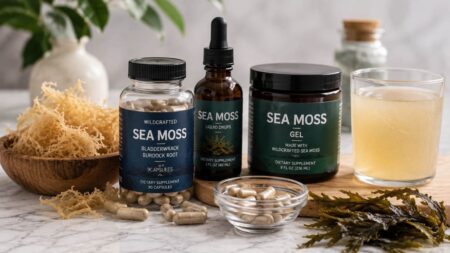
To compare sea moss capsules, gel, and powder, match the format to your daily schedule and your taste tolerance. Capsules travel well and mask the ocean flavor that many first-time users dislike. Gel offers the highest mineral concentration per gram of any format.
Gel requires refrigeration and lasts only about 21 days (3 weeks) after opening. Powder mixes into smoothies and dissolves faster than raw dried moss soaked at home. Raw dried moss costs less per serving but takes 8 to 12 hours to soak before use.
What Are the Top 5 Sea Moss Supplement Categories for 2026?
The top 5 sea moss supplement categories for 2026 are wildcrafted raw moss, standardized capsules, refrigerated gel, blended powder, and thyroid-focused formulas with added kelp. Each category suits a different daily routine and skill level. Review the list below before you commit to one format.
- Raw wildcrafted moss: highest mineral density, longest prep time, best for experienced users
- Standardized capsules: fixed 500-milligram dose, easiest to travel with, best for beginners
- Refrigerated gel: fastest absorption rate, shortest shelf life at 21 days (3 weeks)
- Blended powder: quickest to mix into drinks, moderate potency per gram
- Thyroid-focused blends: added kelp and bladderwrack, best for iodine-deficient diets
Which Category Suits Beginners?
Standardized capsules suit beginners because the dose stays fixed at 500 milligrams (0.018 ounces) per capsule. You avoid the guesswork that comes with measuring raw gel by the spoonful. Capsules also travel through hot climates and long shipping routes without spoiling.
Which Category Suits Experienced Users?
Wildcrafted raw moss suits experienced users who already know how to soak, blend, and store their own gel. You control the final texture and can adjust the mineral strength batch by batch. This category costs less per serving once you buy in bulk.
How Do You Take Sea Moss Supplements Safely?
You take sea moss supplements safely by starting with a half dose for the first 7 days. Your body needs time to adjust to the added iodine load before you reach a full serving. Watch for mild bloating during the first week, which usually fades on its own.
How to Determine the Right Sea Moss Dosage
To determine the right sea moss dosage, follow the milligram amount printed on your product label, not a generic online chart. Most adults tolerate 1 to 2 tablespoons (15 to 30 milliliters) of gel daily. Capsule users should stay within 1,000 to 2,000 milligrams (0.035 to 0.07 ounces) per day.
Split your daily dose between morning and evening meals to reduce stomach upset. Children under 12 years old should only take sea moss under a pediatrician’s direction. Reduce your dose immediately if you notice a metallic taste or a headache.
Who Should Avoid Sea Moss Supplements?
Pregnant women, nursing mothers, and people with hyperthyroidism should avoid sea moss supplements without medical supervision. The iodine concentration can interfere with thyroid medication and natural hormone balance. People taking blood thinners such as warfarin should also avoid sea moss.
Vitamin K in sea moss can reduce the effectiveness of blood-thinning medication. Ask your physician before you combine sea moss with any prescription drug. People with a known iodine allergy should choose a different mineral source entirely.
What Are the Benefits of Sea Moss for Your Body?
Sea moss supports thyroid function, gut health, immune response, and skin hydration through its dense mineral and fiber content. Iodine intake from sea moss helps your thyroid gland produce T3 and T4 hormones correctly. Low thyroid hormone output can otherwise cause fatigue, weight gain, and cold sensitivity.
The prebiotic fiber in sea moss feeds beneficial gut bacteria strains like Bifidobacterium and Lactobacillus. A healthier gut lining improves nutrient absorption from every other meal you eat. Better absorption means you extract more value from your existing diet.
Zinc and vitamin A in sea moss support skin repair and natural collagen production. If you already follow a marine collagen supplement guide for your skin routine, sea moss adds mineral support without extra calories. Combined, the 2 supplements target skin structure from 2 different angles.
How Does Sea Moss Work Alongside Other Natural Supplements?
Sea moss works well alongside other natural supplements when you space out mineral-heavy products across different meals. Combining too many iodine sources in one sitting can push your daily intake past the safe upper limit. Read every label in your supplement cabinet before you add sea moss to the mix.
If anxiety or sleep issues affect you, a valerian root supplement guide can help you pair sea moss with a calming herb instead of stacking 2 stimulant products. Valerian works on your nervous system, while sea moss works on your mineral levels. The 2 supplements rarely interact because they target separate body systems.
Adults who already take a B-vitamin blend should check their label against a best niacin supplement page to avoid duplicate niacin dosing. Some sea moss blends add niacin alongside kelp for extra thyroid support. Duplicate niacin intake above 35 milligrams (0.0012 ounces) daily can cause skin flushing.
How Does Sea Moss Compare to Other Mineral Supplements?
Sea moss delivers a broader mineral spread than single-nutrient supplements like iodine tablets or potassium capsules. A 4-gram (0.14-ounce) serving of sea moss covers iodine, potassium, magnesium, calcium, and zinc in one dose. A single-mineral tablet only addresses 1 nutrient at a time.
Kelp tablets offer a similar iodine boost, but kelp lacks the prebiotic fiber found in sea moss. Multivitamins cover a wider vitamin range, yet most multivitamins skip iodine entirely to avoid overdosing sensitive users. Sea moss fills that specific gap without pushing other vitamin levels too high.
Should You Choose Sea Moss Over a Multivitamin?
You should not replace a full multivitamin with sea moss alone, since sea moss lacks B12 and vitamin D in meaningful amounts. Pair sea moss with your existing multivitamin instead of swapping one for the other. Check both labels together to confirm your combined iodine intake stays under 1,100 micrograms (0.000039 ounces) daily.
Should You Choose Sea Moss Over Kelp Tablets?
Choose sea moss over kelp tablets when you want fiber and a wider mineral spread in one product. Choose kelp tablets instead when you need a stronger, more concentrated iodine dose in a smaller capsule. Some thyroid-focused sea moss blends already combine both ingredients into a single formula.
What Should You Look for on a Sea Moss Product Label?
You should look for the exact species name, the harvest region, the batch number, and the GMP certification mark on a sea moss product label. A label listing only sea moss blend without a species name usually signals a lower-quality supplement. Skip any bottle that lists proprietary blend without a milligram breakdown.
Check the expiration date against the manufacturing date to confirm the shelf life matches your usage plan. Compare the price per serving, not the price per bottle, across different brands and pack sizes. A higher price per bottle does not always mean a higher price per actual dose.
Sea Moss Preparation and Storage Quick Reference
Use the table below to plan your sea moss routine from purchase to daily dose. Each task lists the timing, method, and difficulty level you should expect.
| Task | Timing | Method | Difficulty |
| Soak raw sea moss | 8 to 12 hours | Cold water soak | Easy |
| Blend into gel | 5 minutes | Blender with spring water | Easy |
| Store finished gel | Up to 21 days | Refrigerate in a sealed glass jar | Easy |
| Freeze extra gel | Up to 90 days | Ice cube tray, then transfer to a freezer bag | Easy |
| Take capsules | Daily, with meals | 1,000 to 2,000 milligrams (0.035 to 0.07 ounces) | Easy |
| Review the COA | Before every purchase | Compare lab date and heavy metal results | Moderate |
Frequently Asked Questions About Sea Moss Supplements
Is Sea Moss Safe to Take Every Day?
Yes, sea moss is safe to take every day when you stay within the 1 to 2 tablespoon (15 to 30 milliliter) gel range or the labeled capsule dose. Check with your doctor first if you have a thyroid condition.
Does Sea Moss Help With Weight Loss?
No, sea moss does not directly cause weight loss on its own. The fiber content can reduce appetite, which may lower your overall calorie intake across the day.
How Long Does Sea Moss Gel Last in the Refrigerator?
Sea moss gel lasts about 21 days (3 weeks) in a sealed glass jar inside the refrigerator. Freeze extra portions in ice cube trays to extend shelf life to 90 days (3 months).
Can You Take Sea Moss and Biotin Together?
Yes, you can take sea moss and biotin together without any known interaction risk. Both nutrients support hair, skin, and nail health through separate pathways.
Is Irish Moss the Same as Sea Moss?
No, Irish moss is one specific species called Chondrus crispus within the broader sea moss category. Gracilaria and other red algae species also fall under the general sea moss label.
Final Verdict on the Best Sea Moss Supplements for 2026
Choosing the best sea moss supplements in 2026 comes down to verified sourcing, transparent lab results, and a format that fits your routine. Start with a half dose, check the COA before every purchase, and store your gel in the refrigerator to protect its potency.
Explore the organic collagen supplements guide on Pordeshi to build a complete mineral and skin support routine around your new sea moss habit.