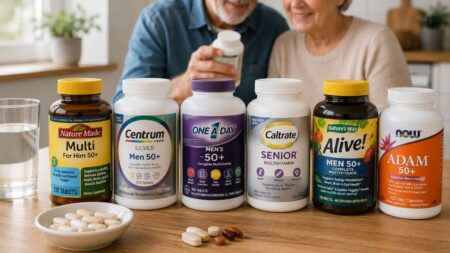
The best multivitamin for seniors over 50 is Centrum Silver Adults 50+ for value or Thorne Basic Nutrients 2/Day for premium nutrient forms. Both formulas exclude iron, raise vitamin B12 and vitamin D3, and swap cheap mineral forms for ones your body absorbs faster.
You lose stomach acid, skin efficiency, and appetite as you age. These 3 changes lower how much vitamin B12, vitamin D, and calcium you pull from food each day. A multivitamin for seniors over 50 closes that gap without adding nutrients you no longer need, such as iron.
This guide compares 5 top-rated multivitamin brands, breaks down the exact nutrient levels that matter after 50, and shows you how to read a supplement label in under 2 minutes. You will also find a quick-reference table for building a daily routine, gender-specific guidance for men and women, and 5 direct answers to common questions elderly buyers ask most.
What Is the Best Multivitamin for Seniors Over 50?
Centrum Silver Adults 50+ and Thorne Basic Nutrients 2/Day rank as the 2 best multivitamins for seniors over 50 in 2026. Centrum Silver costs roughly $0.09 to $0.10 per tablet and delivers 1,000 IU (25 mcg) of vitamin D3, 25 mcg of vitamin B12, and 0 mg of iron. Thorne costs closer to $1.20 per day and uses methylcobalamin B12, methylfolate, and chelated minerals such as magnesium glycinate.
Nature Made Multi 50+, One A Day 50+, and Garden of Life Vitamin Code 50 & Wiser round out the top 5 picks. Each formula targets adults who need higher B12 and vitamin D3 without the iron found in general adult multivitamins. Third-party testing bodies such as USP and NSF verify all 5 brands.
Your choice comes down to 2 factors: budget and nutrient form preference. Choose Centrum Silver if cost drives your decision. Choose Thorne if you want methylated B vitamins and chelated minerals and can pay a higher price per day.
Why Does Your Body Need a Different Multivitamin After 50?
Your stomach produces less acid after age 50, and that acid unlocks vitamin B12 from meat, fish, and dairy. Between 10% and 30% of adults over 50 struggle to absorb dietary B12 for this exact reason. A standard adult multivitamin rarely accounts for this absorption drop.
How Aging Changes Nutrient Absorption
To understand why absorption drops, look at 3 physical changes that happen after 50. Stomach acid production falls, skin thickness decreases by roughly 20%, and kidney function slows with each decade. These 3 changes reduce your ability to activate vitamin D, absorb B12, and retain calcium.
Sun exposure also produces less vitamin D in older skin. A 70-year-old generates about 25% of the vitamin D that a 20-year-old makes from the same 15 minutes (0.25 hours) of midday sun. Indoor lifestyles and sunscreen use lower that output even further.
5 Common Nutrient Deficiencies in Adults Over 50
You face a higher risk of running low on 5 specific nutrients after 50: vitamin B12, vitamin D3, calcium, magnesium, and vitamin B6. Vitamin D3 deficiency affects an estimated 40% to 90% of seniors worldwide, depending on latitude and sun exposure. Magnesium deficiency often goes undiagnosed because standard blood tests miss it. Calcium loss accelerates in women during the first 5 years (60 months) after menopause. Vitamin B6 supports red blood cell production and nerve function, and levels drop as protein intake falls with age.
A study published in The Lancet found that roughly 1 in 4 adults aged 65 or older either suffers from malnutrition or sits at risk of malnutrition. Appetite changes, chewing difficulty, and chronic conditions such as diabetes or kidney disease all reduce nutrient intake at once. Seniors managing 2 or more chronic conditions face the highest combined risk across all 5 nutrients listed above.
What Nutrients Matter Most in a Senior Multivitamin?
A senior multivitamin should prioritize 4 nutrients: vitamin B12, vitamin D3, calcium, and magnesium, while limiting or excluding iron. Look for 100 mcg to 500 mcg of B12 and 1,000 IU to 2,000 IU (25 mcg to 50 mcg) of vitamin D3 as baseline targets. Calcium should sit between 500 mg and 600 mg, since your diet likely supplies the remaining 600 mg to 700 mg you need daily.
Magnesium deserves equal attention, even though most senior multivitamins underdose it. A full multivitamin cannot fit the 200 mg to 350 mg your body needs into 1 or 2 tablets (1.9cm to 2.5cm in length), so many elderly buyers add a separate magnesium glycinate capsule. Vitamin B6 rounds out the priority list at 1.5 mg to 1.7 mg daily, since it supports nerve function and red blood cell production alongside B12.
Vitamin B12 and Vitamin D3 Requirements
To meet your B12 needs after 50, choose a formula with methylcobalamin instead of cyanocobalamin. Methylcobalamin skips a liver conversion step, so your body uses it directly without extra processing. For vitamin D3, aim for 1,000 IU (25 mcg) at minimum, since many standard multivitamins only provide 400 IU (10 mcg). Seniors in northern latitudes or with limited outdoor time often need 2,000 IU (50 mcg) to reach healthy blood levels.
Why Seniors Should Avoid Added Iron
Most adults over 50 do not need supplemental iron, and excess iron accumulates in your liver and heart over years of use. Postmenopausal women and men over 50 rarely have iron deficiency unless a doctor confirms one through bloodwork. Choose an iron-free formula unless your physician recommends otherwise for a diagnosed condition. Our vitamin K supplements guide explains how vitamin K2 works alongside calcium and vitamin D3 to direct calcium toward your bones instead of your arteries.
5 Best Multivitamins for Seniors Over 50 in 2026
These 5 products stand out among dozens of senior formulas sold in 2026. Each listing includes the daily cost and the feature that sets the product apart from competitors.
- Centrum Silver Adults 50+ costs $0.09 to $0.10 per day and delivers 1,000 IU vitamin D3, 25 mcg B12, and 0 mg iron in a single tablet. This formula wins on price and wide availability across pharmacies and online retailers.
- Thorne Basic Nutrients 2/Day costs about $1.20 per day and uses methylcobalamin, methylfolate, and chelated minerals, plus NSF Certified for Sport status. This formula wins on nutrient bioavailability and third-party sport certification.
- Nature Made Multi for Him/Her 50+ costs $0.15 per day and carries USP verification with gender-specific formulas for bone and heart support. This formula wins on verified quality at a moderate price point.
- One A Day Men’s/Women’s 50+ costs $0.22 per day and skips artificial sweeteners and flavors while covering vitamins A, C, D, and E. This formula wins on clean ingredient labels.
- Garden of Life Vitamin Code 50 & Wiser costs $1.31 per day and uses raw, whole-food nutrients with added probiotics for gut health. This formula wins on whole-food sourcing for seniors who prefer minimal processing.
Centrum Silver wins on value for budget-focused buyers. Thorne wins on nutrient quality for buyers who prioritize absorption. Garden of Life wins for seniors who want whole-food, additive-free formulas and can afford a higher price.
How to Choose the Right Multivitamin for Your Needs
To choose the right multivitamin for your needs, check 4 things on the label before buying: nutrient forms, third-party testing, iron content, and tablet size. A third-party seal from USP, NSF, or ConsumerLab confirms the bottle contains what the label claims and nothing else.
How to Read a Supplement Label Correctly
To read a supplement label correctly, start with the % Daily Value (%DV) column listed next to each nutrient. Values above 20% DV count as high, and values under 5% DV count as low. Check the serving size next, since some bottles need 2 to 4 tablets per day to reach the amounts listed on the front label. Compare the inactive ingredients list too, since fillers and dyes vary widely between brands.
How to Check for Third-Party Testing
To check for third-party testing, look for a USP Verified Mark, NSF Certified for Sport logo, or ConsumerLab seal on the front label or brand website. The Food and Drug Administration (FDA) does not test supplements before they reach store shelves. A third-party seal replaces that missing safety check and confirms accurate labeling. Our calcium tablets in Bangladesh roundup applies the same testing criteria to rank locally available brands for bone health.
How to Pick the Right Tablet Size and Format
To pick the right format, match the tablet size to your swallowing comfort before you commit to a full bottle. Standard tablets measure about 0.75 inches (19mm) long, while mini tablets and softgels measure closer to 0.4 inches (10mm). Seniors who struggle with standard pills should choose a mini-tablet line, a liquid formula, or a softgel instead of switching to gummies, since gummies carry the lowest nutrient doses of the 4 formats.
Where Can You Buy These Multivitamins in Bangladesh?
Elderly buyers in Bangladesh can find Centrum Silver and Nature Made through major pharmacy chains and verified online importers that stock international supplement brands. Thorne and Garden of Life ship less frequently to South Asia, so buyers in Dhaka, Chittagong, and other cities often order through authorized distributors or verified e-commerce platforms.
Check the batch number and expiration date on arrival, since heat exposure during shipping can degrade vitamin D3 and B12 potency. Local pharmacist consultation remains valuable even when a product ships from abroad, since your pharmacist can flag interactions with medications common in Bangladesh, such as metformin or blood pressure drugs.
How to Take a Senior Multivitamin Safely
Take your multivitamin with a meal that contains fat, since vitamins A, D, E, and K absorb better alongside food. Split doses across 2 meals if your formula requires 2 or more tablets daily. Tell your pharmacist about every supplement you take if you use 3 or more prescription medications, since interactions become more likely with each added product.
Store your multivitamin in a cool, dry cabinet away from direct sunlight, since heat and humidity break down vitamin D3 and B vitamins over time. Keep the bottle away from bathroom shelves, where steam shortens shelf life by several months. Replace any bottle within 2 years (24 months) of the manufacture date, even if tablets remain inside.
Below is a quick-reference table for building a multivitamin routine into your week.
| Task | Timing | Method | Difficulty |
| Take core multivitamin | With breakfast | 1-2 tablets with food | Easy |
| Add vitamin D3 if needed | With largest meal | Separate softgel | Easy |
| Check for drug interactions | Before starting | Ask your pharmacist | Moderate |
| Review labels | Every 6 months | Compare %DV to current needs | Moderate |
| Schedule bloodwork | Once yearly | Request B12 and D3 panel | Easy |
Do Men and Women Over 50 Need Different Multivitamins?
Yes, men and women over 50 benefit from different multivitamin formulas because their mineral needs diverge with age. Women need more calcium and vitamin D to offset bone loss that accelerates after menopause. Men need more zinc and selenium to support prostate health during the same decade.
Postmenopausal women rarely need supplemental iron, so both gender-specific formulas typically drop it after 50. Choose a women’s formula with 500 mg to 600 mg of calcium and a men’s formula with added lycopene or selenium if prostate health concerns you. Our vitamin D3 supplement guide covers pairing recommendations for bone-support nutrients that work alongside your daily multivitamin.
Frequently Asked Questions
Do seniors really need a multivitamin?
Not always. Seniors with balanced diets and no absorption issues may only need targeted nutrients like vitamin D3. Seniors with limited appetite, chronic conditions, or diagnosed deficiencies benefit the most from a full formula.
What vitamins should someone over 50 take daily?
Vitamin D3 (1,000 IU to 2,000 IU), vitamin B12 (100 mcg to 500 mcg), calcium (500 mg to 600 mg), and magnesium (200 mg to 350 mg) cover the 4 most common gaps after 50.
Is it safe to take a multivitamin with blood pressure medication?
Yes, most multivitamins are safe alongside blood pressure medication, but vitamin K can interact with blood thinners like warfarin. Ask your pharmacist to check your specific prescription list before you start a new formula.
Are gummy multivitamins as effective as tablets for seniors?
No, gummy multivitamins typically contain lower doses of iron, zinc, and calcium than tablets carry. Gummies work better than skipping a multivitamin entirely, but tablets and capsules deliver more nutrition per serving.
How long does it take to notice a difference from a multivitamin?
Most seniors notice higher energy levels within 4 to 6 weeks of consistent daily use. Bone density and cognitive benefits take 6 months to 3 years to show measurable change, based on trial data from large studies.
Your Next Step Toward Healthy Aging
Choosing the best multivitamin for seniors over 50 comes down to 3 checks: iron-free formulation, adequate B12 and D3 levels, and third-party testing. Centrum Silver Adults 50+ fits most budgets, while Thorne Basic Nutrients 2/Day suits seniors who want premium nutrient forms and can pay a higher daily cost. Nature Made, One A Day, and Garden of Life give you 3 more solid options depending on your priorities around price, clean labels, or whole-food sourcing.
Pair your multivitamin with the individual nutrients your bloodwork flags as low, and recheck your levels every year with your doctor or pharmacist. A single formula rarely covers every gap, so treat your multivitamin as your foundation and add targeted nutrients on top of it. Explore our best zinc tablets guide to round out your immune and skin support alongside your daily multivitamin routine.