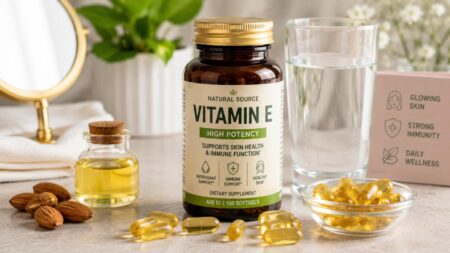
The best vitamin E supplements for skin and immunity in 2026 combine natural d-alpha-tocopherol and third-party lab testing. Doses range from 15 mg to 268 mg, and these formulas protect your skin cells against oxidative stress. They support your immune response at the same time. You get two main forms of vitamin E in most bottles: tocopherols and tocotrienols. Each form targets a slightly different part of your body, so the label matters as much as the price.
Millions of people search for the best vitamin E supplements every year. Most guides skip the dose math and the Bangladesh-specific buying advice you actually need. This guide answers both, plus five direct questions readers ask most.
This guide covers 6 named products, 2 detailed dosage charts, and 1 country-specific buying section. You rarely find all three in a single article. You finish this page knowing exactly which bottle among the best vitamin E supplements fits your goal.
What Does Vitamin E Do for Your Skin and Immune System
Vitamin E protects your cell membranes from free radical damage. This antioxidant action slows visible skin aging and supports immune cell function at the same time.
Your skin uses vitamin E to maintain its barrier against ultraviolet (UV) rays and city pollution. Your immune system uses vitamin E to help white blood cells fight bacteria and viruses more effectively.
Four named forms of vitamin E exist in nature: alpha-tocopherol, beta-tocopherol, gamma-tocopherol, and delta-tocopherol. Four related tocotrienol forms carry the same four names. Alpha-tocopherol is the only form your liver actively stores and redistributes into your bloodstream.
A vitamin E deficiency shows up as dry skin, frequent colds, and muscle weakness. You rarely see deficiency in healthy adults who eat nuts, seeds, or vegetable oils regularly. People with fat malabsorption conditions such as Crohn’s disease or cystic fibrosis face higher deficiency risk. These groups need supplements more often than healthy adults.
Three named food sources deliver the highest natural vitamin E content: sunflower seeds, almonds, and wheat germ oil. A 1-ounce (28-gram) serving of sunflower seeds provides roughly 7.4 mg of vitamin E. Most people still fall short of the recommended 15 mg daily target through diet alone. This gap explains why the best vitamin E supplements remain popular.
How to Choose the Best Vitamin E Supplement for Your Needs
To choose the best vitamin E supplement, match the tocopherol form, dose, and certification to your specific goal. Skin support and immune support call for slightly different formulas, so read the label before you buy.
Check the Tocopherol Form First
Natural vitamin E appears on labels as d-alpha-tocopherol or RRR-alpha-tocopherol, the fully spelled-out natural form. Synthetic vitamin E appears as dl-alpha-tocopherol or all-rac-alpha-tocopherol instead.
Your body absorbs the natural d-alpha form roughly twice as efficiently as the synthetic dl-alpha form. Three named brands that use the natural form include Nature Made, Nordic Naturals, and Life Extension.
Match the Dose to Your Goal
To match your dose to your goal, pick 15 mg (22 IU) for general skin maintenance. Pick 180 mg to 268 mg (400 IU) for stronger immune support instead.
Doses above 1,000 mg (1,500 IU) daily raise your bleeding risk. Stay below this upper limit unless your doctor directs a higher amount for a specific medical condition.
Verify Third-Party Testing
To verify third-party testing, look for seals from NSF International, USP, or Informed Sport on the bottle label.
These three certifications confirm the capsule contains the exact dose printed on the label. They also confirm the product carries no hidden contaminants such as heavy metals or industrial solvents.
Check the Carrier Oil and Allergen List
To check the carrier oil, read the “other ingredients” section below the supplement facts panel. Soybean oil, sunflower oil, and gelatin appear most often as filler ingredients.
Readers with soy allergies should choose sunflower-oil-based softgels such as Nutricost or Doctor’s Best instead of soy-based versions.
What Ingredients Should You Avoid in Vitamin E Supplements
To avoid low-quality vitamin E supplements, skip products listing only “tocopheryl acetate” without specifying the natural or synthetic source. This vague labeling often signals a cheaper synthetic blend.
Avoid bottles using palm oil as the primary carrier without sustainability certification. Three problematic fillers to check for on the label include titanium dioxide, artificial dyes, and hydrogenated oils.
Products certified by NSF International, USP, or Informed Sport rarely contain these lower-quality fillers. Choosing certified brands removes most of the guesswork from picking the best vitamin E supplements for your routine.
Top Vitamin E Supplements Compared in 2026
Six named products lead the best vitamin E supplements category in 2026. These brands include Nature Made Vitamin E, Nordic Naturals Vitamin E Complex, and Nutricost Vitamin E Softgels. The list continues with Life Extension Super Vitamin E, Garden of Life Vitamin Code E, and Doctor’s Best Tocotrienols.
Nordic Naturals combines six tocopherol and tocotrienol forms into one softgel, and it carries non-GMO verification. This full-spectrum approach suits readers who want broad antioxidant coverage rather than a single isolated form.
Life Extension delivers 268 mg (400 IU) of d-alpha-tocopherol per soft gel with no synthetic filler added. This higher-potency option suits readers targeting immune support rather than basic maintenance.
Nutricost offers 180 mg (300 IU) per softgel at a lower price point than most competitors. Each bottle contains 240 softgels. Garden of Life Vitamin Code E adds 900 mcg of vitamin A and 50 mcg of vitamin D. It also includes 61 mcg of selenium alongside 125 mg of vitamin E.
Doctor’s Best Tocotrienols focuses on delta- and gamma-tocotrienols sourced from annatto beans rather than standard tocopherols. This formula suits readers targeting cardiovascular and cellular health alongside skin benefits.
| Brand | Form | Dose | Best For |
| Nature Made Vitamin E | dl-alpha-tocopherol | 180 mg (400 IU) | Budget daily use |
| Nordic Naturals Vitamin E Complex | Mixed tocopherols and tocotrienols | 100% DV | Full-spectrum coverage |
| Nutricost Vitamin E Softgels | d-alpha-tocopherol | 180 mg (300 IU) | Immune support |
| Life Extension Super Vitamin E | d-alpha-tocopherol | 268 mg (400 IU) | High-potency skin support |
| Doctor’s Best Tocotrienols | Delta and gamma tocotrienols | 50 mg | Cardiovascular support |
Price per softgel varies from 8 cents to 45 cents. In Bangladeshi Taka, this equals roughly 9 Taka to 50 Taka across these six brands.
Budget shoppers get the most value from Nature Made or Nutricost. Readers chasing full-spectrum coverage pay more for Nordic Naturals or Garden of Life.
Bottle sizes range from 60 softgels (a 2-month supply) to 240 softgels (an 8-month supply). Larger bottles lower your cost per serving but require proper storage to protect potency over that longer period.
Is Vitamin E Better Than Vitamin C for Skin
Vitamin E and vitamin C work as partners, not competitors, for skin health.
Vitamin-C regenerates oxidized vitamin E molecules, extending their antioxidant lifespan inside your skin cells.
Vitamin E dissolves in fat and sits inside cell membranes. Vitamin C dissolves in water and works inside the cell fluid instead. Choosing one over the other leaves a gap in your antioxidant defense, so most dermatologists recommend both together.
What Is the Right Vitamin E Dosage for Skin and Immunity
The right vitamin E dosage starts at 15 mg (22 IU) for daily skin maintenance. It rises to 268 mg (400 IU) for active immune support.
Daily Dose for Skin Health
To support your skin, take 15 mg to 30 mg (22 IU to 45 IU) of vitamin E daily. Take your dose with a meal containing fat for better absorption. Pair this routine with the best astaxanthin supplement for skin to add a second layer of antioxidant protection.
Fat improves absorption because vitamin E is a fat-soluble vitamin. Three fat sources that help absorption include avocado, olive oil, and whole eggs.
Daily Dose for Immune Support
To support your immune system, take 180 mg to 268 mg (400 IU) daily for 8 to 12 weeks. Many people also add the best zinc tablets to this routine. Zinc and vitamin E target immune cells through different pathways.
Research on older adults shows this dose range reduces upper respiratory infections. Stop the higher dose after 12 weeks unless your doctor extends the timeline.
Dose Adjustments for Specific Groups
Children between 4 and 8 years old need only 7 mg (10.4 IU) daily. Adults over 65 years old often need the higher 180 mg to 268 mg range because absorption declines with age.
How to Take Vitamin E Supplements for Best Results
To take vitamin E supplements for best results, swallow the softgel with your largest meal of the day. Food containing fat increases absorption by up to three times compared to an empty stomach.
Morning or evening timing makes no measurable difference to absorption rates. Consistency matters more than the specific hour you choose.
Pair your vitamin E supplement with vitamin C for an added benefit. Vitamin C regenerates spent vitamin E molecules, so your body reuses them instead of discarding them. Many people also stack vitamin E with vitamin D3 supplements during winter months. Both nutrients run low then, since sun exposure drops.
Store your softgels away from heat and direct sunlight. Heat breaks down the oil inside the capsule and reduces potency over time. A kitchen cabinet 3 feet (1 meter) from the stove stays too warm for long-term storage.
Split your dose into two smaller servings if a single softgel causes stomach upset. Taking 90 mg (150 IU) with breakfast and 90 mg (150 IU) with dinner delivers the same daily total. You get less digestive discomfort this way.
What Are the Side Effects and Risks of Vitamin E Supplements
Vitamin E supplements cause mild side effects in some people: nausea, diarrhea, and fatigue.
Doses above 1,000 mg (1,500 IU) daily increase your risk of bleeding, especially if you take blood-thinning medication.
Three named blood thinners that interact with high-dose vitamin E include warfarin, aspirin, and clopidogrel. Tell your doctor about your supplement routine before starting any of these medications.
Pregnant women should stay below 15 mg (22 IU) daily unless a doctor recommends a higher dose. Vitamin E crosses the placenta, and high doses carry limited safety data for pregnancy.
People scheduled for surgery should stop high-dose vitamin E 14 days (2 weeks) before the procedure. This reduces bleeding risk during and after surgery.
Smokers face a slightly different risk profile than non-smokers. Some research links high-dose vitamin E in smokers to a small increase in lung cancer risk. Smokers should stay closer to the 15 mg (22 IU) baseline dose instead of the higher immune-support range.
Vitamin E Supplements in Bangladesh: What to Know Before You Buy
To buy vitamin E supplements in Bangladesh, check the batch number, expiry date, and importer license printed on the box.
Humidity above 30 degrees Celsius (86 degrees Fahrenheit) degrades softgel capsules faster than tablets. Store your bottle in a cool, dry cabinet away from direct sunlight and away from your bathroom.
Local pharmacies in Dhaka, Chittagong, and Sylhet stock imported brands such as Nature Made and Nutricost. Online retailers such as Pordeshi verify authenticity through sealed packaging and batch tracking on every order.
Prices for a 3-month supply typically range from 800 Bangladeshi Taka to 2,500 Bangladeshi Taka. The final cost depends on the brand and dose. Higher-potency softgels above 200 mg (300 IU) cost more than standard 100 IU tablets.
Bangladesh’s average UV index climbs above 8 for 6 months of the year. This high UV exposure raises your skin’s need for antioxidant support year-round. The best vitamin E supplements and related products fill this need directly.
Customs delays sometimes push imported softgels past their ideal shelf window before they reach store shelves. Ask your pharmacist to check the manufacture date, not only the printed expiry date, before you buy.
Quick Reference Guide
| Task | Timing | Method | Difficulty |
| Take skin-dose vitamin E | Daily with breakfast | 15 mg softgel with a fat source | Easy |
| Take immune-dose vitamin E | Daily with dinner, 8-12 weeks | 268 mg softgel with a fat source | Easy |
| Check third-party certification | Before purchase | Look for NSF, USP, or Informed Sport seal | Easy |
| Store the supplement | Ongoing | Cool, dry cabinet below 30 degrees Celsius (86 degrees Fahrenheit) | Easy |
| Consult your doctor | Before starting, if on blood thinners | Share your supplement list at the appointment | Moderate |
Frequently Asked Questions
Is vitamin E good for skin whitening?
No. Vitamin E does not lighten skin tone. It protects existing skin cells from oxidative damage instead.
Can I take vitamin E every day?
Yes. Adults can take 15 mg to 268 mg (22 IU to 400 IU) of vitamin E daily without issues.
What is the best time to take vitamin E?
The best time to take vitamin E is with your largest meal, since dietary fat increases absorption.
Does vitamin E help hair growth?
Yes. Vitamin E antioxidant action supports scalp circulation and follicle health over time.
Can vitamin E interact with other medications?
Yes. Vitamin E interacts with blood thinners such as warfarin, aspirin, and clopidogrel at high doses.
Conclusion
The best vitamin E supplements for skin and immunity in 2026 combine natural d-alpha-tocopherol and third-party certification on the label. Match your dose to your specific goal. Pordeshi tests every batch for potency and purity before listing it. Explore the best glutathione tablets on Pordeshi’s blog to pair antioxidant support with your new vitamin E routine.