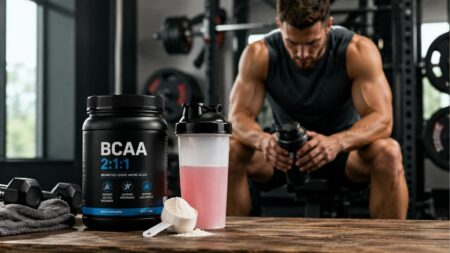
The best BCAA supplements for muscle recovery in 2026 combine a 2:1:1 leucine-to-isoleucine-to-valine ratio with third-party testing. Transparent Labs BCAA Glutamine, Kaged BCAA 2:1:1, and XTEND Original lead this year’s rankings for purity, dosage, and taste.
This guide ranks the top BCAA supplements by leucine content, ratio accuracy, flavor variety, and price per serving. You get a direct answer for every question: which formula suits women, which one fits a tight budget, and how many grams you need each day. Every product listed below carries a published amino acid breakdown, not a hidden proprietary blend.
What Is a BCAA Supplement?
A BCAA supplement delivers three branched-chain amino acids (BCAA) in one dose: leucine, isoleucine, and valine.
These three amino acids sit among 9 essential amino acids your body cannot produce on its own. You get them from food sources such as chicken breast, eggs, and whey protein, or from a powder, capsule, or ready-to-drink format. Manufacturers print ratios such as 2:1:1 or 4:1:1 on the label. The first number always represents leucine, the amino acid that triggers muscle protein synthesis most directly.
Bodybuilders and strength coaches began using BCAA supplements in the 1980s, long before whey protein isolate became widely available. Manufacturers such as Scivation and Xtend built entire product lines around the 2:1:1 ratio during the early 2000s. Today, the category splits into 3 formats: unflavored crystalline powder, flavored powder with electrolytes, and softgel capsules. Each format delivers the same 3 amino acids, though absorption speed varies by 5 to 15 minutes between powder and capsule forms.
What Are the Best BCAA Supplements in 2026?
Transparent Labs BCAA Glutamine ranks as the top BCAA supplement pick for 2026.
The formula delivers 8 grams (8,000mg) of BCAAs plus 5 grams (5,000mg) of L-glutamine per serving. Informed Sport certification lets tested athletes use the product without risking a banned-substance flag. Five flavors give you variety across a 30-serving tub. The product costs more than budget options and skips added stimulants.
Best Tasting BCAA Powder
Kaged BCAA 2:1:1 wins for taste among the top BCAA supplements tested this year. It uses fermented BCAAs at 5 grams (5,000mg) per serving in a research-backed 2:1:1 ratio. The formula ships vegan-friendly, gluten-free, and non-GMO. An unflavored version suits people who mix the powder into other drinks.
Best BCAA Supplement for Women
Swolverine BCAA 2:1:1 earns the top spot for women. It mixes 5 grams (5,000mg) of BCAAs with coconut water, pomegranate, and passionfruit extracts plus added electrolytes. The Lemon-Lime flavor dissolves fully in a shaker cup with no clumping.
Best Budget BCAA Supplement
Nutricost BCAA ranks as the best budget option among current BCAA supplements. It delivers a 2:1:1 ratio at a lower per-serving cost than premium brands such as Transparent Labs or Kaged. The formula skips extras like glutamine or electrolytes, so you pay only for the amino acids.
Best BCAA Supplement for Muscle Growth
1st Phorm BCAA 2:1:1 ranks as the top pick for lifters chasing muscle growth over multiple training cycles. Each serving delivers 5 grams (5,000mg) of BCAAs alongside coconut water powder for hydration support. The brand publishes third-party lab results for every batch, so you confirm the exact leucine, isoleucine, and valine content before you buy. Athletes running a 12-week hypertrophy block report steady strength gains when they pair this formula with 4 to 5 resistance sessions per week.
How Do BCAAs Support Muscle Recovery?
BCAAs support muscle recovery by supplying leucine, isoleucine, and valine directly to muscle tissue during and after training.
Leucine activates a cellular signaling pathway called mTOR, which switches on muscle protein synthesis. Isoleucine helps regulate glucose uptake into muscle cells during exercise. Valine supports energy production across long training sessions. The three amino acids together reduce delayed onset muscle soreness (DOMS) when you take them around your workout window. A 2017 review of multiple resistance-training studies found a 10% to 15% drop in reported muscle soreness among lifters who supplemented with BCAAs before and after training, compared with a placebo group. The effect appears strongest in athletes new to a training program, since untrained muscle experiences more microscopic tissue damage per session.
What Is the Right BCAA Ratio for Muscle Recovery?
A 2:1:1 ratio of leucine to isoleucine to valine works best for most lifters chasing muscle recovery.
This ratio mirrors the natural amino acid profile found in whey protein. Some brands sell 4:1:1 or 8:1:1 ratios that raise leucine content further. Current research on muscle protein synthesis shows no clear recovery advantage for ratios above 2:1:1. Stick with a 2:1:1 formula unless a coach or registered dietitian recommends a different ratio for your specific goal.
Endurance athletes such as marathon runners and cyclists sometimes choose a 4:1:1 ratio for extra leucine during long training blocks. Strength athletes such as powerlifters and bodybuilders generally stay with 2:1:1, since this ratio supports both muscle repair and glycogen-sparing during heavy lifting. Check the milligram breakdown on the supplement facts panel rather than trusting the ratio alone, since a 2:1:1 product with only 2 grams total delivers less leucine than a 4:1:1 product with 8 grams total.
How to Choose the Best BCAA Supplements for Your Goals
To choose the best BCAA supplements for your goals, match the formula to your training type, diet, and budget.
A powerlifter training 4 days per week needs a different formula than a marathon runner logging 60 miles (97km) per week. Compare 3 factors before you buy: total leucine per serving, added ingredients such as electrolytes or glutamine, and third-party test certification. Skip any product that lists “amino blend” without individual milligram amounts, since that labeling hides the true leucine dose.
Check the Leucine Content First
To check the leucine content first, look for at least 2 grams (2,000mg) of leucine per serving. Intake below 2 grams does not reliably trigger muscle protein synthesis. Products such as Kaged BCAA 2:1:1 and Transparent Labs BCAA Glutamine both clear this threshold with transparent labeling.
Match the Format to Your Training Schedule
To match the format to your training schedule, pick a fast-mixing powder for intra-workout sipping and capsules for travel days. Powders such as XTEND Original and Swolverine BCAA 2:1:1 dissolve within 30 seconds in 12 ounces (355ml) of water. If you also chase a stronger training pump, pair your BCAA dose with a nitric oxide product such as the L-Citrulline for performance formula covered on Pordeshi Blog.
Should You Take BCAAs During a Cutting Phase?
Yes, you should take BCAAs during a cutting phase to protect lean muscle while you eat fewer calories.
A calorie deficit raises the risk of muscle breakdown, since your body searches for extra energy sources beyond stored fat. BCAAs supply 5 grams (5,000mg) of amino acids per serving with almost 0 calories, so you avoid extra intake while you train fasted. Dieters who cut 500 to 750 calories per day from their maintenance level report less strength loss when they add a BCAA dose before fasted cardio. Combine your BCAA supplement with a high-protein diet of 1.8 to 2.2 grams per kilogram (0.8 to 1 gram per pound) of body weight for the best result during a cut.
How to Take BCAA Supplements for Best Results
To take BCAA supplements for best results, mix 5 to 10 grams (5,000mg to 10,000mg) with 8 to 12 ounces (240ml to 355ml) of water.
Drink the mixture 15 to 30 minutes before training, sip it during your session, or drink it within 30 minutes after your last set. Fasted lifters gain the most benefit from an intra-workout dose, since BCAAs limit muscle breakdown when no other protein sits in your stomach. If you already eat 20 to 30 grams of whey protein around your workout, a BCAA supplement adds limited extra value on top of that dose.
Quick-Reference: BCAA Timing and Method
| Task | Timing | Method | Difficulty |
| Pre-workout dose | 15-30 min before training | Mix 5g in 8oz (240ml) water | Easy |
| Intra-workout dose | During training | Sip 5-10g across the session | Easy |
| Post-workout dose | Within 30 min after training | Mix 5g in 8oz (240ml) water | Easy |
| Fasted training dose | Immediately before fasted sessions | Mix 10g in 12oz (355ml) water | Moderate |
| Stacking with creatine | Same time as BCAA dose | Combine 5g creatine with the BCAA serving | Moderate |
Are BCAA Supplements Better Than EAA or Whey Protein?
No, BCAA supplements are not better than whey protein for total muscle growth.
Whey protein contains all 9 essential amino acids (EAA), while a BCAA supplement contains only 3. A complete EAA product also outperforms a BCAA-only formula for muscle protein synthesis, based on testing published by BarBend and Garage Gym Reviews. BCAAs work best as a low-calorie addition during fasted training or a cutting phase, not as a full replacement for daily protein intake. A single scoop of whey protein delivers roughly 20 to 25 grams of protein and all 9 EAA in one dose, while a typical BCAA scoop delivers only 5 to 10 grams across 3 amino acids. Choose whey protein or a complete EAA blend first, then add a BCAA supplement only for intra-workout convenience. Pordeshi Blog’s Amino Energy review compares a caffeinated amino acid blend against a standard BCAA powder for lifters who want extra focus.
Do BCAA Supplements Have Side Effects?
Yes, BCAA supplements can cause mild digestive side effects in some users.
Bloating, nausea, and stomach cramps appear most often at doses above 20 grams (20,000mg) in one sitting. People with maple syrup urine disease must avoid BCAA supplements entirely, since their bodies cannot break down these amino acids. Pregnant women and people with liver conditions should consult a doctor before starting a BCAA regimen. Most healthy adults tolerate 5 to 10 grams (5,000mg to 10,000mg) per day without an adverse reaction. Flavored BCAA powders that use sugar alcohols such as erythritol or xylitol can cause additional gas or loose stools in people sensitive to those ingredients. Read the full ingredient panel, not just the amino acid facts box, before you commit to a full tub. If you already take a nitric oxide booster such as an L-Arginine supplement guide product, space your BCAA dose 30 minutes apart to check for stacking effects on your stomach.
Where Can You Buy BCAA Supplements in Bangladesh?
You can buy BCAA supplements in Bangladesh through international retailers such as iHerb and Amazon Global, or through local supplement importers in Dhaka.
Import duties add 20% to 45% to the sticker price, depending on the product category and courier. Gyms and supplement shops in Dhaka and Chattogram stock brands such as XTEND and MuscleTech at a markup over US pricing. Check the expiration date and batch number on any imported tub before you pay, since heat during shipping can degrade some flavor compounds. Order unflavored powder when possible, since unflavored formulas ship with fewer temperature-sensitive additives.
Delivery through international couriers such as DHL or FedEx typically takes 7 to 14 days from a US or UK warehouse to Dhaka. Local reseller pages on Facebook and Daraz list smaller BCAA tubs, though buyers should confirm the seller ships sealed, factory-original packaging. Ask any local seller for a batch photo before payment, since counterfeit sports supplements circulate in some South Asian markets. A verified pharmacy or a listed gym supply shop offers more protection than an unverified online reseller.
Frequently Asked Questions
Do BCAA supplements build muscle by themselves?
No, BCAA supplements do not build muscle by themselves. You need a caloric surplus, resistance training, and total daily protein above 1.6 grams per kilogram (0.7 grams per pound) of body weight. A BCAA supplement works as a support tool alongside those 3 factors, not as a stand-alone muscle-building product.
How many grams of BCAAs should you take per day?
Take 5 to 10 grams (5,000mg to 10,000mg) of BCAAs per day, split across your pre-workout and post-workout windows.
Can you take BCAA supplements every day?
Yes, you can take BCAA supplements every day. Daily use at 5 to 10 grams causes no known long-term harm in healthy adults.
Is BCAA powder better than BCAA capsules?
BCAA powder mixes faster into intra-workout drinks and reaches muscle tissue sooner. Capsules travel better and skip added sweeteners for people watching sugar intake. Choose capsules if you dislike the taste of amino acid powder, since most capsule formulas carry no flavor at all.
Do BCAA supplements expire?
Yes, BCAA supplements expire. Most tubs list a shelf life of 24 months from the manufacture date, after which potency drops.
Final Recommendation
Transparent Labs BCAA Glutamine, Kaged BCAA 2:1:1, and Swolverine BCAA 2:1:1 stand out among the best BCAA supplements for muscle recovery in 2026. Pick a formula with a 2:1:1 ratio, at least 2 grams (2,000mg) of leucine per serving, and third-party testing. Pair your BCAA dose with adequate daily protein, consistent training, and enough sleep for full recovery. Revisit your formula every 3 to 4 months, since new batches, flavors, and price points enter the market on a regular basis. Read Pordeshi Blog’s organic collagen supplements guide next to round out your full muscle recovery stack.