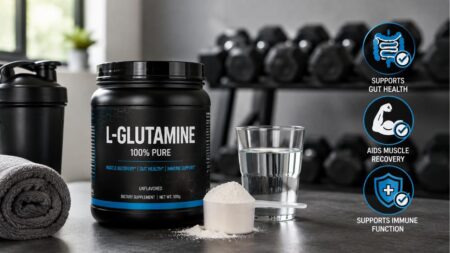
The best l-glutamine supplements for gut and muscle in 2026 combine a pure 5 gram (0.18 oz) serving with third-party sport certification. Thorne, NOW Sports, and Jarrow Formulas top this list for dose accuracy and lab-verified purity. This guide ranks 6 products by evidence, certification, and cost per serving. You will also learn exact dosing for gut repair, muscle recovery, and general daily use.
What Are the Best L-Glutamine Supplements for Gut and Muscle in 2026?
The best l-glutamine supplements for gut and muscle in 2026 share 3 traits: a single-ingredient free-form formula, a 5 gram (0.18 oz) dose per scoop, and a recognized certification mark such as NSF Certified for Sport or Informed Sport. L-glutamine is the most abundant amino acid in human blood, and it fuels enterocytes, the cells lining your small intestine.
Your gut absorbs roughly 30% of dietary glutamine before the amino acid reaches your bloodstream, so gut-focused users typically need a higher daily dose than general users. Athletes use l-glutamine to lower muscle soreness after eccentric training sessions, while gut-health users take it to strengthen intestinal barrier function. This guide covers both use cases with named product examples: Thorne, NOW Sports, Jarrow Formulas, Nutricost, Klean Athlete, and Momentous.
Food sources such as dairy, eggs, beef, tofu, and spinach supply glutamine naturally, but intense training, illness, surgery, or chronic stress can push your demand above what food alone provides. Supplementation closes that gap with a precise, measurable daily dose.
How Does L-Glutamine Support Gut and Muscle Health?
L-glutamine supports gut and muscle health through 2 separate mechanisms: intestinal barrier repair and muscle protein synthesis.
Enterocyte Fuel and Intestinal Barrier Repair
Enterocytes, the epithelial cells lining your intestine, use l-glutamine as their primary fuel source ahead of glucose. A 2018 randomized controlled trial (RCT) published in the journal Gut gave 106 patients with post-infectious irritable bowel syndrome (IBS-D) 15 grams (0.53 oz) of l-glutamine per day for 8 weeks.
Researchers recorded a 79.6% responder rate in the glutamine group versus 5.8% in the placebo group, measured by reduced intestinal permeability on a lactulose-to-mannitol test.
L-glutamine also supports tight junction proteins such as claudin, occludin, and zonula occludens-1 (ZO-1), which hold intestinal cells together and limit paracellular permeability. Runners benefit too: a 2015 study found that oral glutamine before endurance exercise reduced exercise-induced intestinal permeability in recreational athletes.
Muscle Protein Synthesis and Soreness Reduction
Skeletal muscle stores roughly 60% of your body’s free glutamine, and heavy training depletes this store fast. A 2015 clinical study measured muscle soreness and peak torque recovery after eccentric exercise in subjects given l-glutamine supplementation.
Researchers recorded faster peak torque recovery and lower reported soreness scores in the supplemented group compared with placebo.
L-glutamine does not build muscle mass on its own. Creatine monohydrate carries stronger evidence for strength and power gains, so treat l-glutamine as a recovery tool rather than a primary muscle-building supplement. Pair it with adequate dietary protein from sources such as chicken, eggs, lentils, and fish for measurable recovery benefits.
How to Choose the Best L-Glutamine Supplement for Your Goals
Choosing the best l-glutamine supplement starts with 3 factors: form, certification, and dose size per serving.
Powder Versus Capsules for Daily Dosing
Powder delivers gram-level dosing with 1 scoop, typically 5 grams (0.18 oz) per serving. Capsules hold 500 to 1,000 milligrams (0.02 to 0.04 oz) each, so reaching a 15 gram (0.53 oz) gut-health dose requires 15 to 30 capsules per day.
Choose powder if your primary goal is gut barrier repair at the clinically studied 15 gram (0.53 oz) dose. Choose capsules if you travel often, dislike mixing drinks, or prefer a pre-measured format for smaller maintenance doses.
Certification Marks That Matter
NSF Certified for Sport tests every production batch against more than 270 substances banned by the World Anti-Doping Agency (WADA). Informed Sport runs equivalent batch-level testing at a lower licensing cost, which often lowers the retail price for the buyer.
Good Manufacturing Practice (GMP) certification confirms a clean, controlled facility but does not test the finished product for banned substances. Pick NSF Certified for Sport or Informed Sport products if you compete in a drug-tested sport such as track, powerlifting, or professional cycling.
Top 6 Best L-Glutamine Supplements Ranked for 2026
These 6 products rank among the best l-glutamine supplements for 2026 based on certification, dose accuracy, and cost per gram. Each pick fits a distinct budget or performance goal.
1. Thorne L-Glutamine Powder — Best Overall
Thorne packs 5 grams (0.18 oz) of free-form l-glutamine per scoop with zero additives, fillers, or excipients. NSF Certified for Sport status makes it the top pick for athletes in tested sports such as Olympic weightlifting and professional soccer. Each tub delivers 90 servings at roughly $0.60 to $0.70 per serving. The premium price fits tested athletes more than casual users chasing a budget option.
2. NOW Sports L-Glutamine Powder — Best Value Certified
NOW Sports carries Informed Sport certification at roughly $0.10 to $0.15 per 5 gram (0.18 oz) serving. A 2.2 pound (1 kg) tub covers a full 15 gram (0.53 oz) daily gut-health protocol for under $5 per week. This product offers the strongest cost-to-certification ratio among the options in this guide.
3. Jarrow Formulas L-Glutamine Powder — Best Mid-Range
Jarrow Formulas sells a single-ingredient, GMP-certified powder at a mid-range price point. Each scoop provides 5 grams (0.18 oz) of free-form l-glutamine with no sport-specific certification attached. Choose Jarrow if you want an established supplement brand without paying extra for NSF or Informed Sport testing.
4. Nutricost L-Glutamine Powder — Best Budget
Nutricost offers the lowest cost per gram among the products in this guide, at roughly $0.08 to $0.12 per 5 gram (0.18 oz) serving. The powder carries GMP certification but lacks NSF or Informed Sport testing. Budget-focused users running the full 15 gram (0.53 oz) daily protocol save the most money with this option.
5. Klean Athlete Klean Recovery — Best for a Recovery Blend
Klean Recovery combines l-glutamine with branched-chain amino acids (BCAAs) and other recovery compounds in 1 NSF Certified for Sport formula. Each serving costs roughly $1.00 to $1.50, reflecting the multi-ingredient blend rather than glutamine alone. Choose this product if you want broader post-exercise recovery support beyond standalone glutamine.
6. Momentous L-Glutamine — Best for Combined Gut and Recovery Support
Momentous delivers 5 grams (0.18 oz) of NSF Certified for Sport l-glutamine per scoop at roughly $0.66 per serving. The formula mixes easily into water and dissolves without grit or aftertaste. Momentous fits users who want gut support and post-workout recovery from the same product, since the brand markets both use cases directly.
How to Take L-Glutamine for Gut Repair and Muscle Recovery
To take l-glutamine for gut repair, mix 5 grams (0.18 oz) with water 3 times per day for a 15 gram (0.53 oz) total daily dose.
Daily Dose for Gut Barrier Support
To dose l-glutamine for gut barrier support, split 15 grams (0.53 oz) into 3 servings of 5 grams (0.18 oz) each. Take 1 serving with each meal for 8 weeks, matching the protocol used in the 2018 Gut trial. Track symptoms such as bloating, cramping, and stool consistency in a daily log to compare week 1 against week 8. Stop the trial and consult a clinician if symptoms worsen at any point during the 8 weeks.
Timing Around Workouts
To time l-glutamine around workouts, take 1 serving of 5 grams (0.18 oz) within 30 minutes after training ends. Mix the powder into a post-workout shake, plain water, or a non-hot beverage of your choice. Consistency across days matters more than exact timing relative to your workout window. Skip the pre-workout dose if you already run a full gut-health protocol with 3 daily servings.
How Does L-Glutamine Compare to Other Popular Amino Acid Supplements?
L-glutamine differs from other popular amino acids in target and mechanism. L-carnitine transports fatty acids into your cell mitochondria for fat metabolism, which supports weight loss goals rather than gut repair. L-citrulline converts into L-arginine to boost nitric oxide production, which improves blood flow and workout pumps rather than intestinal barrier function. L-theanine works on brain chemistry, promoting calm focus through GABA and alpha brain wave activity rather than physical recovery.
Combining l-glutamine with 1 of these amino acids can address multiple goals at once. A lifter chasing both gut comfort and blood flow might stack l-glutamine with L-citrulline, while a dieter focused on fat loss might pair l-glutamine with L-carnitine for combined metabolic and digestive support.
What Side Effects and Safety Precautions Should You Know?
L-glutamine causes mild stomach discomfort in some users, especially at single doses above 10 grams (0.35 oz). Reduce your serving size or split doses further across the day if bloating occurs after your first week.
People with kidney disease, liver disease, active cancer treatment, or pregnancy should get clinician guidance before starting high-dose amino acid supplementation. Critical-care research on intravenous glutamine in intensive care unit (ICU) patients does not transfer to retail oral powders; the REDOXS trial raised safety concerns at very high clinical doses used for critically ill patients.
Store your powder in a sealed, airtight container away from heat and direct sunlight, since Bangladesh’s humid climate degrades unprotected powder faster than dry, temperate storage conditions.
Quick-Reference Table: L-Glutamine Dosing by Goal
This table summarizes timing, method, and difficulty for the 4 main l-glutamine use cases covered in this guide.
| Task | Timing | Method | Difficulty |
| Gut barrier repair | 3 times daily, with meals | 5g powder in water, 15g total | Moderate |
| Muscle recovery | Within 30 min post-workout | 5g powder in a shake | Easy |
| General maintenance | Once daily | 5g powder or 2 capsules | Easy |
| Certified athlete stack | 2 to 3 times daily | NSF Certified for Sport powder | Moderate |
Where to Buy L-Glutamine Supplements in Bangladesh and Beyond
Buyers in Bangladesh face 2 common obstacles: limited local retail stock and high shipping costs on bulky tubs from international sellers. Order 2.2 pound (1 kg) tubs instead of small containers to lower the per-gram shipping cost on international orders placed through Amazon Global or verified resellers.
Check customs duty rates before ordering, since amino acid powders typically clear as general food supplements rather than restricted goods.
If gut discomfort already affects your daily routine, review the best glutathione tablets guide on Pordeshi Blog for a complementary antioxidant approach, since glutathione shares glutamine as a building block in its synthesis.
Runners and lifters recovering from soreness can also compare the best L-citrulline supplements for blood-flow-focused recovery support that pairs well with a glutamine protocol.
If your goal includes fat loss alongside gut repair, the L-carnitine for weight loss guide explains a metabolism-focused stack that complements a daily glutamine routine.
Frequently Asked Questions About L-Glutamine Supplements
Is l-glutamine safe to take every day?
Yes. Daily doses of 5 to 15 grams (0.18 to 0.53 oz) show a strong safety record in healthy adults across multiple published trials.
Does l-glutamine help build muscle?
No. Current evidence supports recovery and soreness reduction, not direct muscle growth, in well-fed healthy trainees following normal training programs.
How long does l-glutamine take to work for gut health?
Expect 4 to 8 weeks of consistent 15 gram (0.53 oz) daily use before you evaluate gut barrier improvement accurately.
Can you take l-glutamine with or without food?
Yes. The most successful clinical protocol split 3 doses with meals, though daily consistency matters more than exact timing.
What is the difference between l-glutamine and glutamine?
L-glutamine is the biologically active form your body uses. Every commercial supplement and clinical trial referenced in this guide uses this specific form.
Final Verdict on the Best L-Glutamine Supplements for 2026
Pick the best l-glutamine supplement for 2026 by matching your goal to a specific product: Thorne for certified athletes, NOW Sports for value-focused gut protocols, and Nutricost for tight budgets. Start your 8-week trial at 15 grams (0.53 oz) daily, split into 3 servings, and track your results every week.
For a wider gut-health stack, browse the best glutathione tablets guide on Pordeshi Blog to pair antioxidant support with your new glutamine routine today.